Anti-СОРМ and Protection Against "Chat Control": An Overview of Key Next-Gen Decentralized Messengers
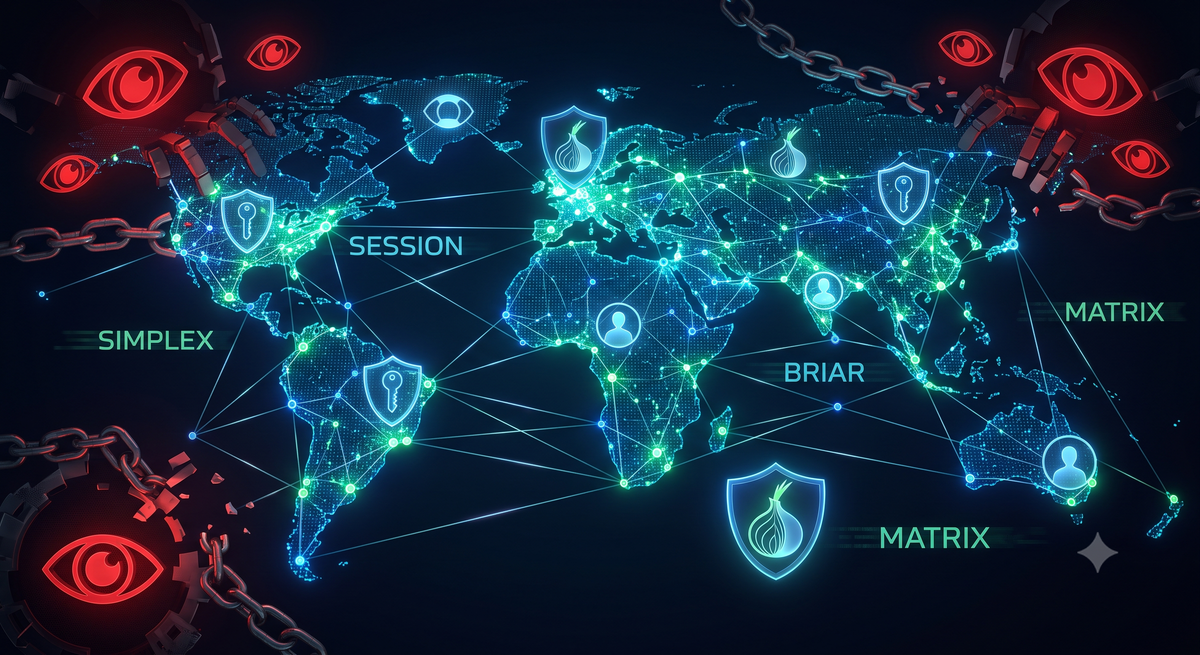
It is no secret that while the tightening of digital surveillance ramps up worldwide—from Canada's C-22 to Europe's Chat Control—traditional messengers are gradually ceasing to be a safe haven. Even services using end-to-end encryption still harbor a major vulnerability: they require a phone number for registration, rely on centralized servers, and meticulously gather metadata (who messaged whom, when, and from where).
If a server can be blocked, coerced into cooperation, or disconnected from infrastructure, the digital resistance's answer has been a shift toward decentralization. Let's look at the primary independent messengers built to operate under conditions of total surveillance.
1. Session: A Messenger Without Numbers or Servers
The Session project has become one of the most popular solutions for those who value ease of use without compromising anonymity.
- How it works: Instead of a phone number, users are assigned a long, unique Account ID. All messages are transmitted through a decentralized network of nodes using onion routing (similar to Tor).
- Key advantage: Total detachment from real-world identity and hidden IP addresses. No servers store your chat history or contact list.
2. SimpleX Chat: Absolute Metadata Protection (Zero Identifiers)
If Session eliminates phone numbers, SimpleX Chat goes even further by completely abandoning even unique user IDs.
- How it works: SimpleX has no concept of a "user account" or a "global address." Communication relies on one-time pairwise message queues. To message someone, you exchange a single-use link or QR code. The relay server passes encrypted packets, but technically cannot tell whether the incoming and outgoing queues belong to the same person.
- Key advantage: Complete invisibility of the social graph. Even if intelligence agencies intercept the server traffic, they cannot prove that User A communicated with User B.
3. Briar: Communication for Blackouts and Internet Shutdowns
Briar was created specifically for activists, journalists, and operations in extreme environments.
- How it works: It is a peer-to-peer (P2P) network where messages are passed directly from device to device. When the internet is available, Briar routes data through the Tor network. If the internet is completely shut down (blackouts, network kills), the app transmits encrypted data via Bluetooth and local Wi-Fi, turning users' smartphones into a mesh network.
- Key advantage: Resilience to hybrid threats. The app cannot be blocked at the ISP level because it lacks central servers and can function entirely without access to the global web.
4. Matrix (Element): Decentralization for Teams and Communities
Unlike personal messengers, the Matrix protocol and its most popular client, Element, target team communication as an alternative to platforms like Slack, MS Teams, or Telegram work chats.
- How it works: The model resembles email (federation). Any individual or organization can spin up their own server (HomeServer) and retain total control over their data. Meanwhile, users across different servers can seamlessly communicate with end-to-end encryption (E2EE) enabled.
- Key advantage: Scalability, support for group chats, channels, voice/video calls, and the ability to host the entire infrastructure on your own physical servers.
What Are the Pitfalls?
This begs the question: if these services are so great, why hasn't the whole world switched to them already?
I would assume the primary reason is the price paid for uncompromising security in the form of user experience (UX):
- Recovery complexity: There is no "Forgot Password" or "Restore via SMS" button. Losing your 12-to-24-word seed phrase means losing your account and contacts permanently.
- Speed and battery consumption: Routing data through three onion nodes or constantly maintaining a P2P connection consumes slightly more battery and works slower than a centralized tech giant's server.
- Finding contacts: You cannot simply sync your address book; every contact must be added manually via QR codes or long cryptographic keys.
What Remains for Users?
Looking at how regulators try to force ISPs to log metadata and push tech giants to build in backdoors, it becomes clear: the era of "convenient privacy" is coming to an end.
- First, we will have to diversify our toolset. Conventional services will remain for everyday matters and public channels, but sensitive personal communication will require adopting serverless protocols like Session or SimpleX Chat.
- Second, it is wise to keep P2P clients installed on your device—such as Briar —in case of emergency connectivity blackouts or harsh ISP-level blocks. Decentralized technology is no longer just a hobby for tech geeks; it is the only viable way to preserve messaging privacy in the 21st century.
Comments ()