Europe Wants Its Own "Chat Control": How Privacy Is Being Stripped Away Under the Guise of Security
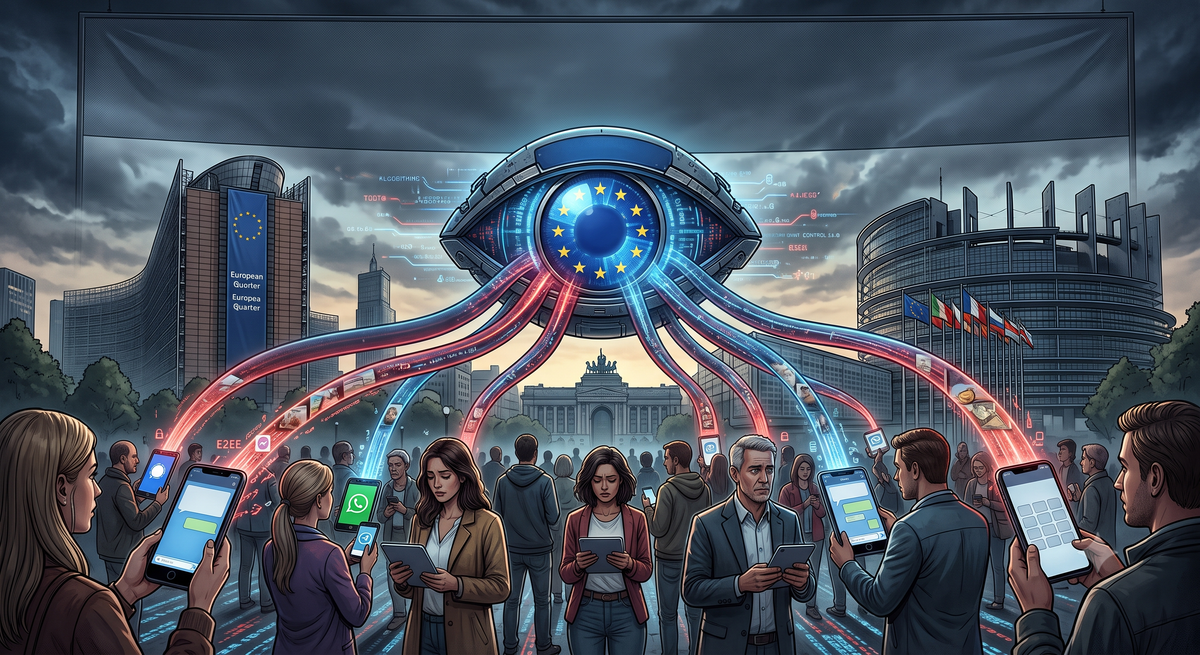
It is no secret that European officials have long had their eyes on total control over the digital space. While previous surveillance attempts were justified under the banner of fighting terrorism or money laundering, they have now deployed a far more bulletproof shield: protecting children from abuse. Yet behind these good intentions, as is so often the case, lies a desire to control users and their communications, with privacy advocates' arguments shattering against purely bureaucratic loopholes.
The initiative known as Chat Control 1.0 is a temporary derogation from ePrivacy rules that allows tech companies to scan citizens' private messages. Back in March, Members of the European Parliament (MEPs) had already voted against extending this law, but the story didn't end there. In late June, European Parliament President Roberta Metsola revived the document and sent it to the Council of the EU, after which the proposal was kicked back to Parliament right at the start of the holiday season. The calculation was spot-on: gathering the required absolute majority in an empty chamber to block it a second time was practically impossible.
The result was sheer procedural absurdity. A simple majority of MEPs (314 in favor of rejection and 276 against) voted to block the law. However, due to the lack of an absolute majority (360 votes), a second reading effectively never took place, and the document automatically went to the Council of the EU for approval. As a result, the temporary mass-scanning regime was extended straight through to April 2028—buying time to comfortably finalize an even stricter, permanent Chat Control 2.0 law.
What will tech companies and communication services have to do? Simply put, messaging apps, social networks, and email providers will be forced to integrate automated content-scanning systems into private chats. The liberal RENEW group attempted to introduce a "softening" amendment to exclude channels protected by End-to-End Encryption (E2EE) from scanning. But this looks like little more than a cosmetic concession. True end-to-end encryption and mass content monitoring are technically incompatible—one mutually excludes the other. Experts have no doubt that the Council of the EU will simply scrap this amendment, as it completely undermines the bill's logic.
This raises an obvious question: won't creating such backdoors inevitably lead to abuses, data leaks, and surveillance targeted at political opponents or dissenters? It seems that is precisely where this is headed. As human rights advocates rightly point out, the EU is systematically normalizing the erosion of privacy. First, society was conditioned to financial surveillance, then movement tracking, and now the crosshairs are on personal conversations. An instrument built supposedly for noble causes inevitably gets repurposed for coercion and political pressure.
What is left for European citizens if this trend continues?
- First, they will have to say goodbye to the concept of absolute privacy in mainstream messaging apps. True privacy will be relegated either to niche decentralized services or driven into underground channels.
- Second, they will need to proactively learn data protection techniques and ways to bypass scanning algorithms. The main battle for encryption will take place in the fall during debates over Chat Control 2.0, and civil society will need to find ways to counter these bureaucratic tricks if they don't want to wake up in a world where every sent photo is vetted by a government bot.
Comments ()