Free vs. Paid: How "Free" VPN Services Make Money Off You
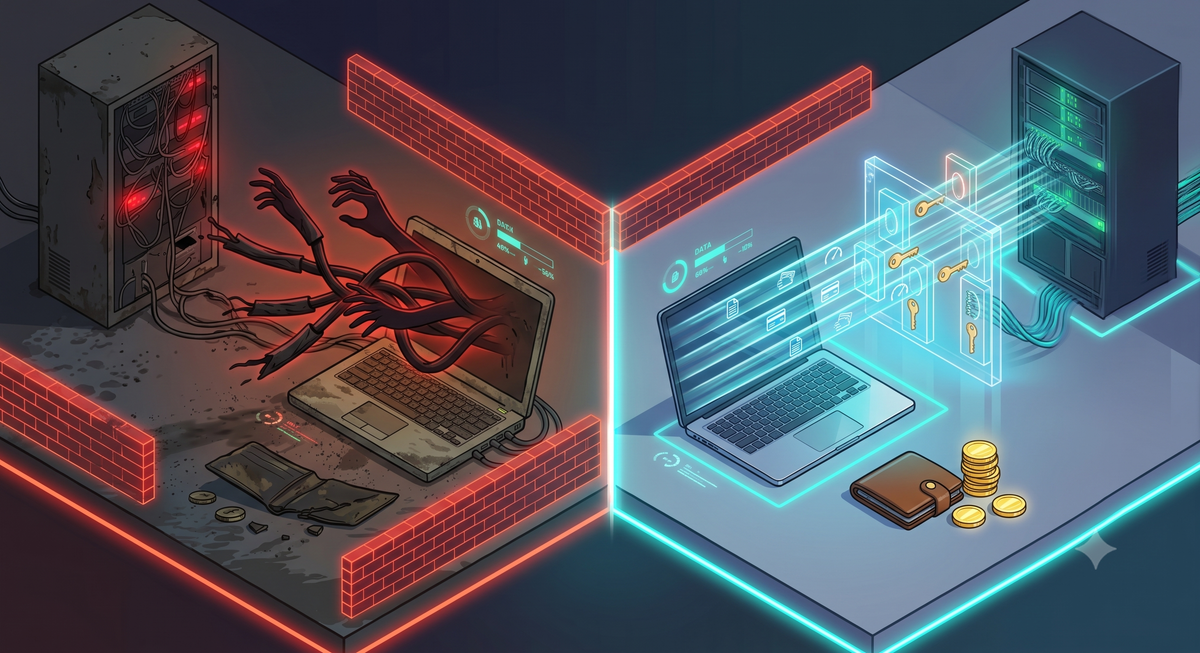
In the digital age, the principle "if you are not paying for the product, you are the product" has become a fundamental rule of the IT industry. When residents across Western Europe download another "free VPN" from the App Store or Google Play, they often expect to safeguard their personal data, evade ISP surveillance, or bypass streaming geo-restrictions.
However, maintaining server infrastructure in major European data centers (such as Amsterdam, Frankfurt, or London), leasing gigabit uplinks, and supporting multi-platform apps requires substantial financial resources. If a service does not charge its users, it inevitably finds alternative ways to monetize their traffic.
Three Primary Ways "Free" Traffic Is Monetized
Instead of protecting privacy, non-commercial applications frequently turn into tools for mass data harvesting and resource exploitation.
1. Collecting and Selling Metadata to Data Brokers
By connecting to a VPN, you grant the service operator full access to your outgoing traffic. Rather than upholding privacy standards, free services log:
- Browsing history and app usage;
- Exact geographic location and timestamps;
- Unique device identifiers (IMEI, MAC address, advertising ID).
For advertisers, data from European users carries premium value. These data sets are aggregated and sold to data brokers, who build digital profiles for targeted advertising or credit scoring.
2. Selling Your Internet Bandwidth (Residential Proxies)
This represents the most dangerous scenario for the user. Certain popular free VPNs include clauses in their terms of service granting them the right to use your device and home internet connection as an exit node for third-party clients.
Your home IP address is then sold to corporate clients or proxy networks as a Residential Proxy. If an external actor uses your IP address for automated data scraping, spamming, or launching cyberattacks, European law enforcement agencies or ISP inquiries will be directed straight to your doorstep.
3. Injecting Ads and Tracking Scripts
Free mobile clients are often heavily loaded with third-party advertising SDKs (Software Development Kits). Furthermore, when browsing unencrypted (HTTP) websites, these VPNs can inject third-party JavaScript code into loaded pages on the fly, swapping out original ads for their own or injecting affiliate cookies to hijack referral commissions.
The Illusion of GDPR and Legal Loopholes
Residents of the European Union are accustomed to relying on the protections of the General Data Protection Regulation (GDPR). However, free VPN creators excel at bypassing these regulatory frameworks:
- Offshore Jurisdictions and Shell Companies: The vast majority of popular free VPN apps are registered in offshore havens (such as the Seychelles or the British Virgin Islands) or Hong Kong, where the identities of actual beneficial owners remain hidden. Holding them legally accountable under GDPR is practically impossible.
- Consent by Default: By clicking "Accept" upon first launching the app, the user legally gives voluntary permission for the collection, processing, and transfer of their data to third parties.
A Transparent Business Model as the Only Guarantee of Integrity
True network security cannot be free. Reliable infrastructure requires a direct and transparent financial model.
By purchasing a paid subscription or renting a personal Virtual Private Server (VPS) in a European jurisdiction, you eliminate the primary conflict of interest:
- A Clear Contract: You pay for server rental, network bandwidth, and software development. The provider has no incentive to sell your data because the business model is already profitable.
- Genuine No-Logs Policies: Paid services can afford regular independent security audits (conducted by firms like Deloitte or PwC) to verify the absence of activity logging.
- Guaranteed Speed and Resources: Without an influx of overcrowded "free" users, the provider can deliver dedicated gigabit bandwidth without throttling 4K streaming or large file downloads.
Using a "free" VPN in Western Europe is a risky trade-off that exchanges the illusion of privacy for real security vulnerabilities. By handing your traffic over to undisclosed app owners, you risk becoming a target of surveillance or an unwitting accomplice to illicit online activity.
A transparent business model—whether through a direct subscription or a self-hosted VPN deployed on a personal VPS—remains the only reliable way to maintain digital hygiene and ensure that your personal data remains strictly your own.
Comments ()