Incognito vs. VPN: What Is the Difference and What Actually Protects Your Data?
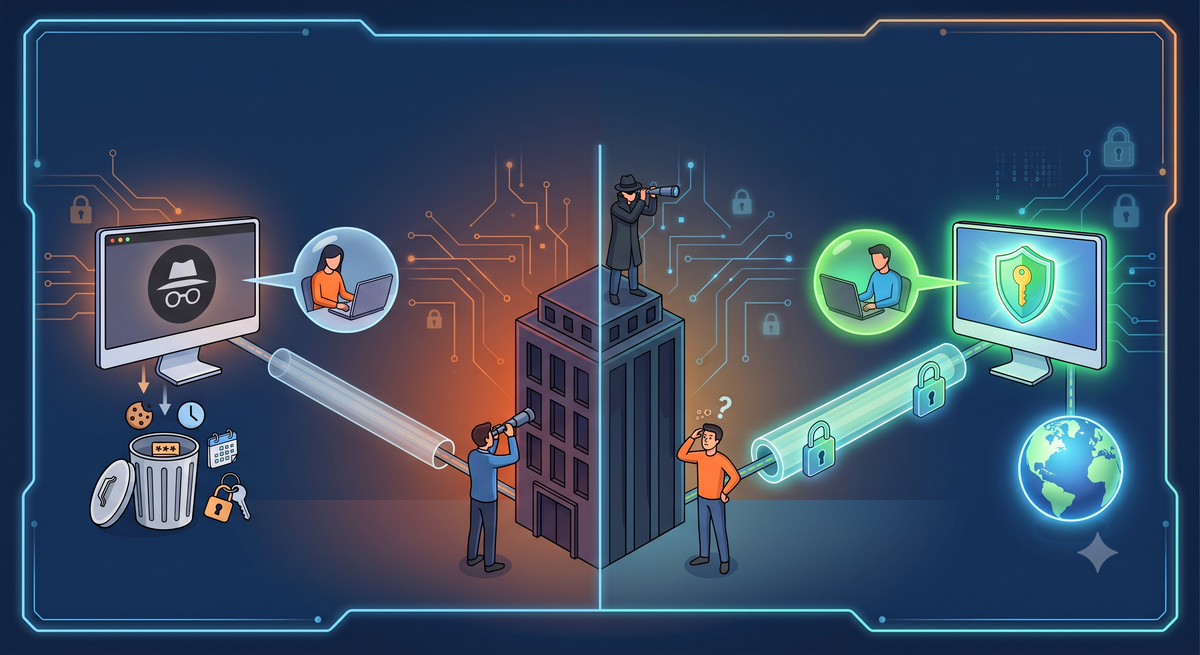
What Does "Incognito" Actually Do?
Incognito is an anonymity mode that isn't suitable for everyone. What purposes does this mode actually serve?
- Does not require/retain long-term cookie files;
- Does not save browser history;
- Does not save information entered on websites or passwords;
- Clears cached images and files after closing the session.
The mode handles these tasks well. However, many mistakenly believe that enabling it completely isolates them online. Incognito mode does not save your local search history, but that does not equal privacy—data can still be tracked via your IP address, and an Internet Service Provider (ISP) will see absolutely all actions taken in Incognito mode. Furthermore, there are legal mandates requiring providers to log and store information about their clients' browsing data.
While Incognito mode increases privacy by a small margin, it does not protect against cyber threats, which are extremely prevalent today.
Based on the above, one might ask: "Is this mode actually safe?" Let's look at the scenarios where it is useful:
- Incognito is great for people using a shared or public device;
- It can be used to temporarily reduce targeted advertising;
- When managing multiple accounts on a single website, it allows you to log in simultaneously from different accounts.
What Does Your Internet Service Provider (ISP) See?
Legislation is impartially tightened every year under the umbrella of public safety. The digital realm is no exception—cybercriminals are constantly advancing in all types of online fraud.
So what is an ISP, what must an ISP track today, and what information must it store?
An Internet Service Provider is the entity that provides your connection to the web (companies like Comcast, AT&T, Vodafone, Megafon, or Rostelecom are ISPs).
What information does an ISP know and have to store?
An ISP knows your location data, MAC address, and IP address. Consequently, it logs all visited websites, time spent on them, entered search queries, and applications used.
In the European Union, under data retention regulations (such as ePrivacy frameworks and national data retention laws), providers are obligated to store specific user metadata.
Why does your provider need your data?
First and foremost, it is a regulatory requirement; everything else stems from that:
- Legal compliance: Providers are legally mandated to collect and store user connection logs;
- Technical maintenance and billing: To bill you correctly, the provider must monitor how much traffic you consume or how many minutes you use;
- Commercial gain: Marketing analytics and data insights;
- Targeted advertising: Monetization through partner networks and ad services.
How to Become Truly Invisible and Stay Safe
Disappearing completely from a provider's radar is difficult (since they supply your physical internet access), but you can encrypt your traffic.
Traffic encryption turns your online activity into an unreadable string of characters for anyone attempting to eavesdrop.
A VPN (Virtual Private Network) is precisely the tool that can ensure security and preserve privacy during an active connection.
Why privacy matters:
- To stop your ISP from selling your digital footprint: Since your provider sees every site you visit, encryption—especially via a VPN—hides the final destination addresses from the ISP.
- Protection on public Wi-Fi (cafes, subways, hotels): Public networks are a playground for hackers. The owner of a Wi-Fi hotspot (or a bad actor intercepting signals nearby) can view all unencrypted traffic.
- Bypassing artificial restrictions: If you live in or travel to a region where specific platforms or news sites are blocked, encryption bypasses these restrictions. The provider cannot see your destination, preventing them from dropping the connection.
- Preventing traffic shaping (throttling): Some providers intentionally lower your connection speed if they detect torrent downloads or 4K video streaming in order to decongest the network. When your traffic is encrypted, the provider cannot determine its content type (whether it is video, streaming, or regular files) and cannot selectively throttle your connection.
In an era where your data and online activity are constantly targeted from all sides, maintaining digital security is essential. A reliable VPN is an effective solution. It is important not only to use one for your safety, but also to choose a trustworthy provider.
Incognito = Local cleanliness on your computer.
VPN = Real privacy across the network.
Comments ()