The Illusion of Anonymity: Child Safety or Mass Surveillance?
We’ve heard so many conversations everywhere about the need to protect children from information on the Internet that is not intended for them. Some argue that access should simply be cut off until the age of majority, some talk about filtering, others about "only in the presence of adults."
But let’s agree that at the moment, no one has a clear solution to this issue. There are quite a few ways to obtain information, and regulating everything is an almost utopian task. Nevertheless, some are still trying to do it.
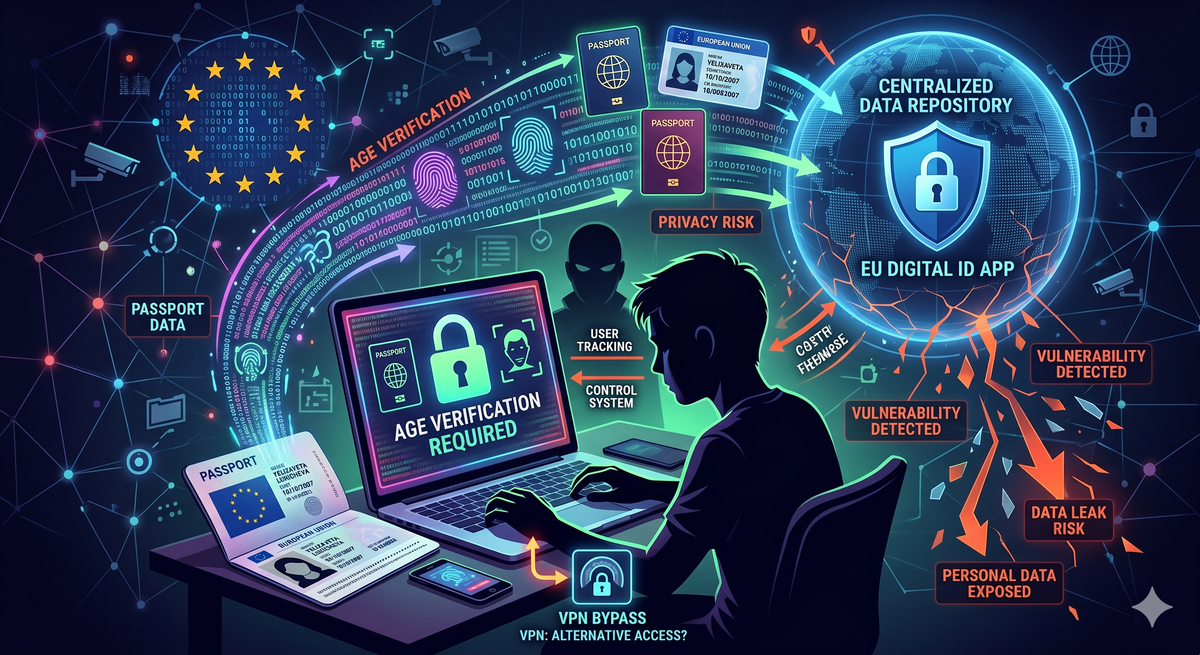
Recently, I saw a news item in my feed stating that the European Union has developed a certain app to perform age verification when accessing online platforms. For verification, it is proposed to scan a passport or other identity document and upload it to this platform.
According to the assurances of the President of the European Commission, Ursula von der Leyen, it will look like an application for smartphones and computers that will ensure anonymity and the impossibility of tracking resource visitors.
And right here, a thought crept in: how can anonymity be ensured if you upload, for example, your passport for identification? This is a document that identifies you directly in the first place!
So, okay, I read further and see that the service used during the COVID-19 pandemic to check whether a person was vaccinated or not will be taken as a basis. As far as I remember, for the most part, it was then needed to allow movement between countries when the pandemic outbreaks were still raging. But there was no anonymity there; you were confirming that you yourself were vaccinated or had recovered.
Based on this, a doubt arises whether it is even possible to provide a kind of anonymity and not transfer non-anonymized data to various IT corporations. After all, it turns out that someone, in any case, will be able to link a specific person to a certain digital "avatar," as they are the intermediate link between them. And where are the guarantees here that personal data will not go to someone else or that someone who should not have access to it will get it?
Then, a couple of days later, the next news item comes out, which makes me doubt this idea even more. It turned out that cybersecurity experts found a way to bypass the restrictions of this application in just a couple of minutes. There is a major vulnerability in how personal data is stored and how it is protected.
And here I thought once again about how much one can remain anonymous on the Internet today. It turns out that, effectively, not at all. In this chain of transferring any data, there is always a probability that it will be possible to gain access to personal information and identify a person. Moreover, cybersecurity specialists claim that users can change confidential data if this was overlooked during the development of identification systems, which means someone can impersonate another. Scammers would only be happy about this.
It turns out that under the guise of restricting the younger generations from information, in fact, any such system can be a control system for all users. Collecting statistics and information about one access or another to some information that could compromise a person or even set them up.
And the most interesting thing is that access can be obtained without hacking anyone. As usual, you can simply take advantage of another person’s elementary forgetfulness and just gain access while they are not looking.
It turns out that simply creating an app-service and connecting resources to it with information differentiation is not such a simple task. Success requires taking into account many nuances and factors that will need to be brought together. And, maybe, then such an idea will work. But for now, I remembered again the words that the biggest vulnerability of any system is the human himself, who does not realize what he is doing and does not follow recommendations for ensuring the preservation and restriction of access to information.
What is the conclusion? It is not easy to just impose bans on everyone and launch surveillance, so children are "put into play."
Or, there is another option, which is convenient because it allows you to flexibly change the exit point — a VPN. If we fall under the jurisdiction of one state that requires such authorization, then we can take advantage of the fact that another does not require it, which means we can use the service without the additional risk of exposing some personal data. The main thing is to choose the right service that does not store your personal data and anonymizes your presence as much as possible.
Comments ()