Your Walls Might Have Ears
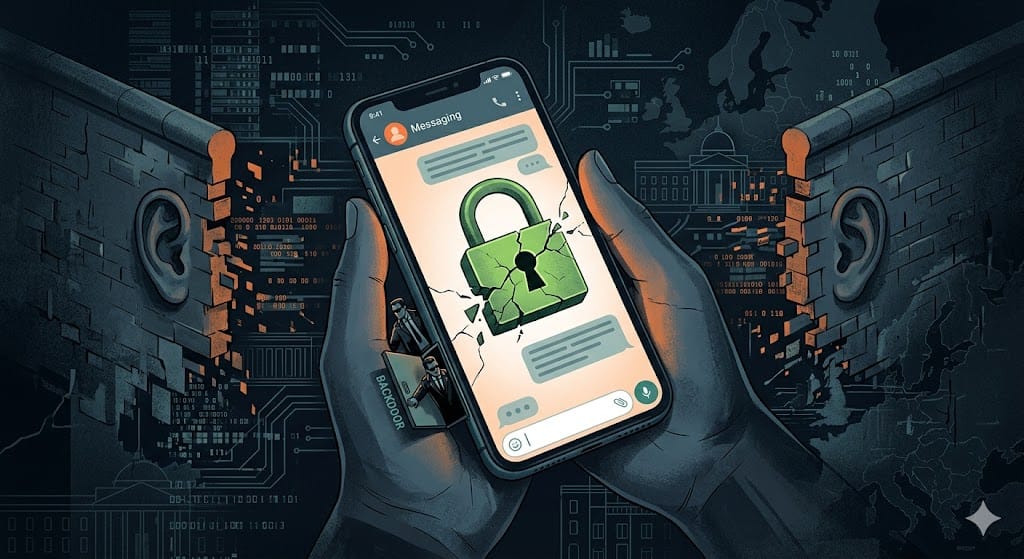
The article title features a well-known expression meaning that you can be overheard even when you are certain you are alone in a room. How does this apply to the digital world? Perhaps now, in the most direct way possible.
The French parliamentary intelligence delegation has officially supported breaking the encryption that protects messages in WhatsApp, Signal, and Telegram. They recommended granting judges and intelligence officers targeted access to messages that the platforms themselves currently cannot read.
This refers to End-to-End Encryption (E2EE), where encryption keys reside on the communication endpoints. In the case of instant messengers, these are the so-called private or secret chats, which are accessible only on the device where the chat was created and used. Messages passing through the servers are encrypted, and the service itself cannot decrypt them—such is the fundamental principle of this cryptographic method.
Back in April 2026, Telegram founder Pavel Durov reported on his Telegram channel that the French Senate had passed a law to implement a backdoor for police access to private messages. At that time, the country's National Assembly did not support it.
The European Commission has also proposed a similar idea of introducing a backdoor into user correspondence for security agencies to monitor.
What does all of this mean? Let's try to break it down and understand whether we should ultimately expect this to happen or not.
How It Works vs. What Is Being Proposed
To start, let me remind you that the principle of any cryptography lies in the fact that encryption and decryption can only be performed by the communicating parties who have exchanged encryption keys to hide the information during transmission. This means anyone attempting to intercept and decode this data stream in transit will only get a jumble of chaotic characters that make absolutely no sense.
So, what is being proposed instead? To create master keys that will always decrypt information, regardless of when the encryption keys for a specific dialogue were generated. In other words, a passphrase will no longer be generated using random numbers; it will always remain the same.
The consequences of such a decision are easy to foresee: there will be an immense temptation to seize these keys to influence people. This applies not just to law enforcement agencies, but to cybercriminals as well. Deception, blackmail, and many other threats could arise from this method of exposing private correspondence.
Comments ()